By Marcel Hagens, Tamyka Perine, and Kaelin Richardson
At the Regional Response Team (RRT), we are passionate about advancing innovative solutions in education, healthcare, housing, and economic mobility. Our work, which prioritizes in-kind technical assistance, coaching, and systems change expertise, leverages partnerships to invest in community-rooted projects that seek to eliminate racial and other inequities.
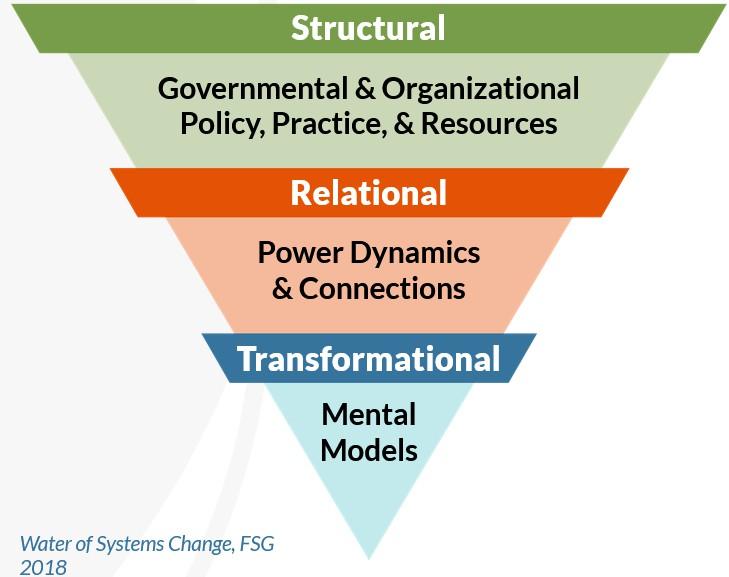
RRT utilizes a framework for systems change centering on explicit and implicit motivators that contribute to societal conditions. Our model, adopted from ‘Waters of Systems change’ 1, encompasses the structural, or most explicit motivators (e.g., change in legislation, expansion, or contraction of resources, etc.) and highlights the significance and influence of the more implicit relational and transformational motivators. Relational motivators speak to interpersonal connections and the distribution of power among individuals and organizations.
Transformational motivators identify mental models, or implicit bias, that influence decision-making. This model illustrates that strong, sustainable improvements in systems require changes on multiple levels of society, and the RRT leverages this strategic framework to maximize impact.
As part of this approach, our team elevates regional challenges and provides in-kind strategic and facilitative support to advance solutions. A key area of our 2025 work – early childhood education and care – exemplifies how interventions across each level of systems can catalyze change.
The Impact of Early Childhood Education and Care
Time and time again, research shows investing in early childhood education programs improves outcomes for children, families, and communities. The first five years of a child’s life pave the way for their long-term well-being, and investing in those early years — which is essential even if “just” to support that child — also pays dividends to our region.
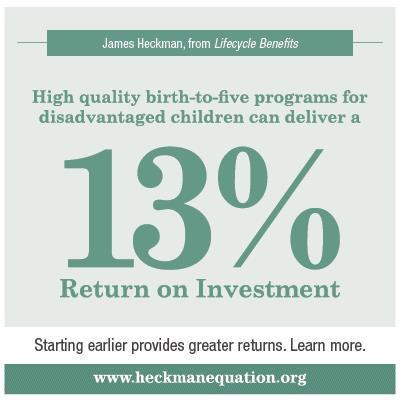
Everything from increased school readiness and educational attainment to improved employment and health is tied to a strong, sustained commitment to quality early learning programs and services. In fact, studies show every $1 invested in early learning can save up to $10 in future costs related to education, healthcare, and the justice system.
Challenges in the Bistate Early Learning Ecosystem
Unfortunately, despite these proven impacts, families continue to face barriers in finding and accessing quality early learning programs. Across the City of St. Louis and Madison, St. Clair, and St. Louis Counties, over 38,000 children lack access to publicly funded early learning seats. This leaves families in limbo as they deal with long wait lists, are forced to use services that don’t meet their needs, or scramble to cover out-of-pocket costs that can exceed $15,000 per child each year. For families with multiple kids, do the math — it adds up quickly.
These challenges cross borders as families, educators, and employers move fluidly across counties and the Mississippi River, yet policies, funding streams, and quality standards remain tied to municipal and state boundaries. The resulting fragmented systems fail to deliver for children, and they stretch staff who are simply trying to meet the needs of our foundational skills to potentially make them more productive in the future workforce.
Promising Solutions
A straightforward solution to these challenges lies in strong, connected early learning systems that serve the whole family’s needs, which many are already working toward in Missouri and Illinois.
Illinois
Illinois has made long-standing investments in early learning, recognizing the promise and importance of a child’s early years. Commitments like the centralized Department of Early Childhood and Birth to Five Regional Councils, which connect families with decision makers, work to bridge gaps in service coordination’s ability to meet family needs.
Multiple home-grown early learning collaboratives bring together educators, community leaders, and families to advance a shared strategy that improves access, experience, and outcomes, mobilizing people to champion early learning in their communities. With a community approach to wrap-around services, these early learning collaboratives elevate family voice through statewide leadership pipelines, strengthen service coordination to meet families’ basic needs, and invest in welcoming childcare homes and centers.
Missouri
While early childhood advocates have access to fewer state resources in Missouri, a dynamic network of leaders continue working toward affordable, quality care.
Advancing Impact through the Child Care Assistance Program Pilot
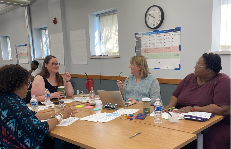
To help regional partners advance these crucial, ambitious goals, the RRT is partnering with Brightpoint, an Illinois child and family service organization, to improve childcare access, usability, and impact for unhoused families, families involved in the child welfare system, and families with parents deployed in active military. The effort is driven by a systems change pilot that provides dedicated space for partners to co-design and test service innovations.
Promising solutions will be scaled across two key Brightpoint programs: Child Care Resource and Referral (CCR&R), which provides information and resources to help families find an early learning program that meets their needs, and the Child Care Assistance Program (CCAP), which connects eligible families to a state subsidy for care.
Currently, this partnership has engaged ten community organizations and four early learning collaboratives to illuminate opportunities for program improvements that better meet the needs of children and families.
Ways to Support
High-quality early childhood education is more than a boost for kids; it’s a game-changer for our communities. When families have access to reliable, affordable care, parents and caregivers can work and advance in their careers, strengthening our local workforce and economy and creating a thriving region for all.
Now is the moment to act. Investing in early childhood is not just the right thing for kids, it’s the smart thing for our region’s future. Together, we can ensure every child, regardless of ZIP code, has the opportunity to learn, grow, and succeed.
To donate or learn more about how to get involved, contact one of the collaboratives below:


Greater East St. Louis Early Learning Partnership
Danayka Saavedra Berrocal, Community Engagement Manager
Madison County Alliance for Children and Families
Christina Owens, Childcare Resource and Referral Community Supervisor
Footnotes
1 Kania, J., Kramer, M., & Senge , P. (2018, June). The Water of Systems Change. The Water of Sytems Change. https://www.fsg.org/wp-content/uploads/2021/08/The-Water-of-Systems-Change_rc.pdf
2 Solomon, C. (2025, March 7). Research summary: The Lifecycle Benefits of an influential early childhood program. The Heckman Equation. https://heckmanequation.org/resource/research-summary-lifecycle-benefits-influential-early-childhood-program/. Research suggests that investment in high-quality, birth-to-five programs for disadvantaged students shows a considerably higher return on investment than that of investment in preschool programs targeting 3- to 4-year-olds alone. These investments also have a multi-generational impact; mothers with access to high-quality, birth-to-five programs have improved economic prospects, while their children gain the foundational skills to potential make them more productive in the future workforce.
Responses